
1. Why patios fail in Michigan
Michigan is hard on patios. Water soaks into the ground, freezes, expands, and thaws again, over and over every winter. When there's water trapped under a patio, that freeze-thaw cycle pushes pavers up, then lets them drop. Over a few seasons you get dips, wobbly pavers, and cracked edges.
Almost every failed patio we tear out has the same problems underneath:
- Too little base. A thin layer of stone can't spread the load or keep frost from moving things.
- Water with nowhere to go. No slope, or a base that holds water instead of draining it.
- Pavers set on sand. Sand holds water and slowly washes out, leaving low spots.
- Loose edges. Without a solid edge, pavers creep outward over time.
2. How we build a patio that lasts
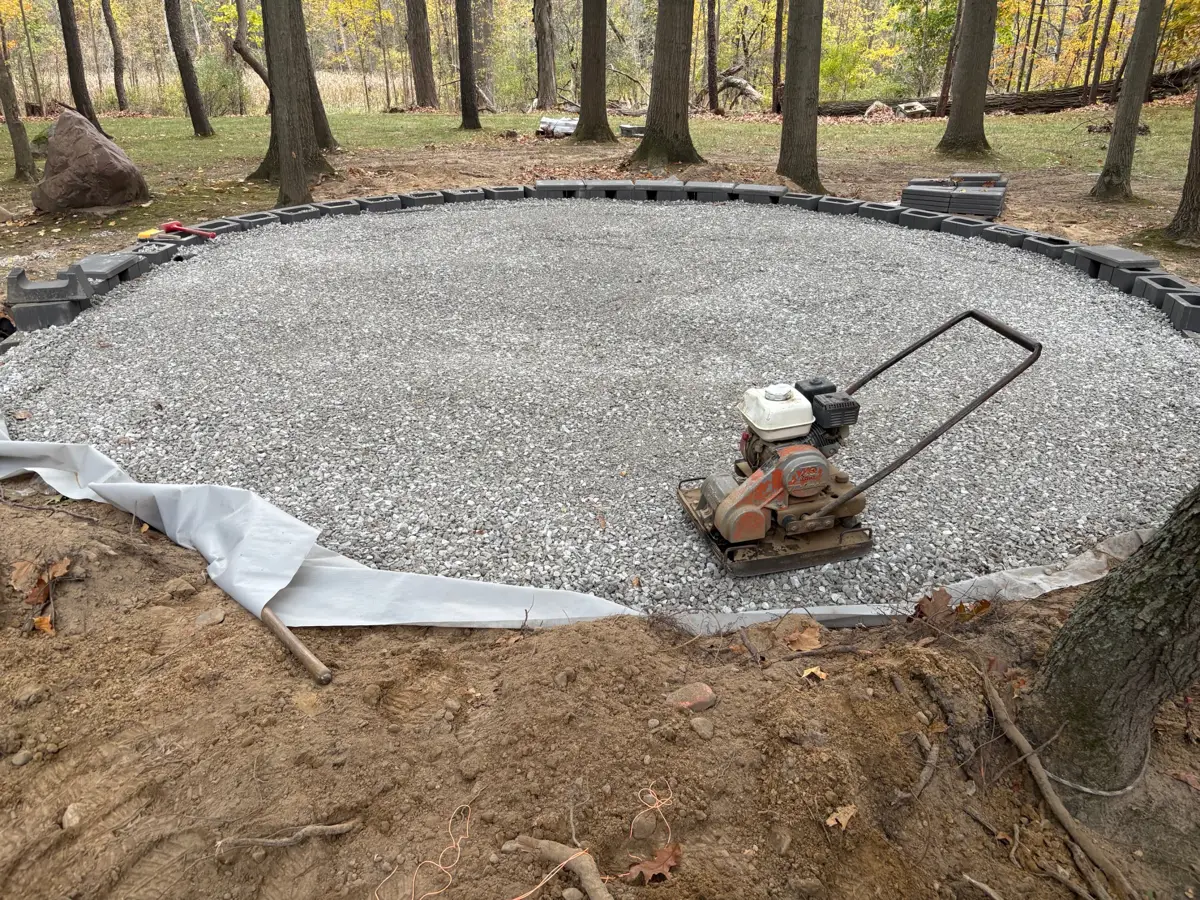
- Plan the layout and drainage. We decide where water will go before we dig, and pitch the patio away from your house.
- Excavate. We dig out deep enough for a minimum of 6 inches of base under the pavers, and go deeper where the soil or the use calls for it.
- Fabric where the soil needs it. Depending on your soil type, we lay geotextile fabric under the base to keep clay and dirt from mixing up into the stone over time.
- Open-graded permeable base, compacted in layers. We use clean, open-graded 57 stone, not dense-grade. We compact it in layers so it's solid, while water can still drain down through it.
- Permeable bedding stone, not sand. Pavers sit on a layer of 3/8" chip stone instead of sand, so water drains through instead of washing the bedding out.
- Lay the pavers and lock the edges. Pavers go down in your chosen pattern, with a solid edge restraint so they can't creep.
- Fill the joints and compact. Joints are filled with polymeric sand or a permeable joint filler, depending on the project, and the whole surface is compacted to lock everything together.
- Clean up. We leave the site clean every day, and walk the finished patio with you.
3. Open-graded vs. dense-graded base
The stone under your patio matters more than the pavers on top. Many patios are built on dense-graded base (like 21AA), which packs tight but also holds water. We build on open-graded 57 stone with a 3/8" chip setting bed instead.
| Open-graded (what we use) | Dense-graded | |
|---|---|---|
| Water | Drains down through the stone | Holds more water near the surface |
| Freeze-thaw | Less trapped water to freeze and heave | More risk of heaving if water can't drain |
| Bedding layer | Pairs with permeable stone bedding | Usually paired with sand bedding |
4. Pavers vs. poured concrete vs. stamped concrete
| Pavers | Poured concrete | Stamped concrete | |
|---|---|---|---|
| Freeze-thaw | Flexes; individual pavers can move without cracking | Prone to cracking | Prone to cracking |
| Repairs | Lift and replace a few pavers | Patch or replace slabs | Hard to patch invisibly |
| Look | Many colors, shapes, and patterns | Plain | Patterned, colored |
| Up-front cost | Higher | Lower | Middle to higher |
5. What affects the cost
Every yard is different, which is why we give free on-site estimates instead of a flat price. The biggest factors are:
- Size and shape of the patio, and how many curves or cuts it needs.
- Access for equipment, like a tight backyard vs. open access.
- Tear-out of an old patio or concrete.
- Grade and drainage work needed to get water moving the right way.
- Extras like steps, seating walls, a fire pit, or borders.
- Paver style you choose.
6. Caring for your patio
- Sweep and rinse a few times a year to keep joints clean.
- Pull weeds early before roots settle into joints.
- In winter, use a plastic shovel or a plow with a rubber edge, and ask us which ice melt is safe for your pavers.
- Call us if a section ever settles. Pavers can be lifted, re-leveled, and reset.
7. Paver patio FAQs
How long do paver patios last in Michigan?
A paver patio built on a properly excavated, well-drained, compacted base can last for decades. Most failures we see come from a thin base, poor drainage, or pavers set on sand that washed out, not from the pavers themselves.
Why don't you set pavers on sand?
Sand holds water and can slowly wash out from under pavers, which leads to dips and loose pavers. We set pavers on clean, open-graded permeable stone so water drains through instead of carrying the bedding away.
Are pavers better than poured concrete?
For most Michigan patios, yes. Pavers flex with freeze-thaw cycles instead of cracking, and a single damaged paver can be lifted and replaced. Poured concrete usually costs less up front but tends to crack over time and is harder to repair.
Can you build a patio in the fall or winter?
Often, yes, as long as the ground isn't frozen or saturated. We'll tell you honestly if conditions aren't right to build a base that lasts.
How long does a paver patio take to install?
Most residential patios take a few days once work starts, depending on size, access, and whether an old patio has to be torn out first.
Planning a patio?
Get a free on-site estimate and a written quote within 48 hours.
Get a Free Estimate (989) 577-9421